
Insider Brief
- Neura Robotics and Seco formed a strategic partnership spanning robot compute hardware, industrial data collection and physical AI automation, with plans to develop and manufacture key computing components for Neura robots in Europe.
- Seco will design, engineer and manufacture Qualcomm Dragonwing-based compute modules for Neura’s cognitive robots, including the 4NE1 humanoid, while the companies also plan to open a Neura Gym in Italy and collect real-world production data from industrial deployments.
- Neura and Seco plan to use that data to develop physical AI automation for semiconductor and electronics manufacturing, while positioning the partnership as part of a broader European physical AI ecosystem built around regional robotics, manufacturing and engineering capabilities.
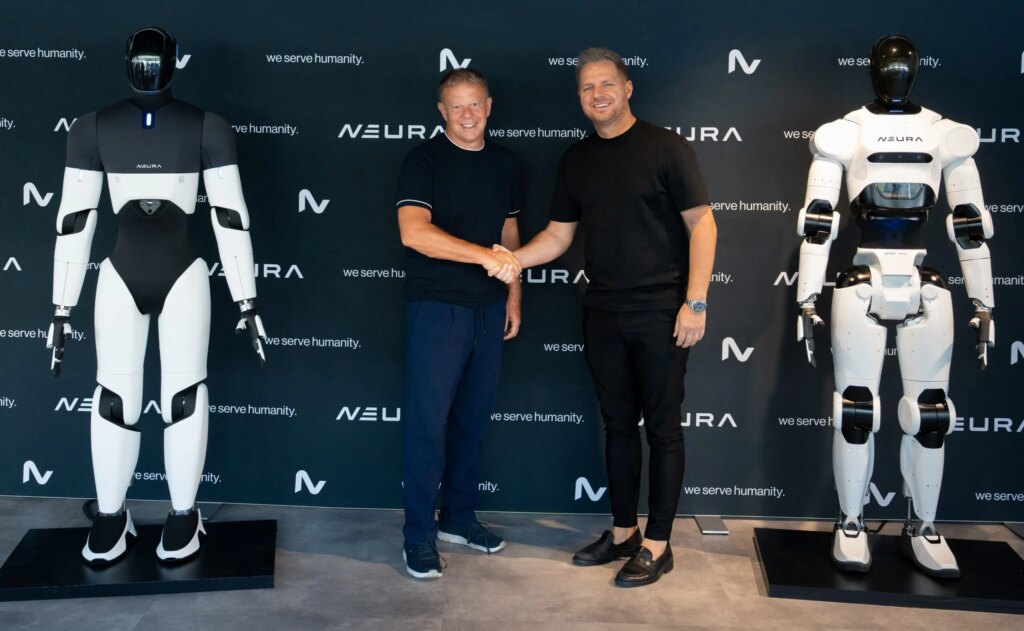
Germany’s Neura Robotics and Italian edge AI company Seco have formed a strategic partnership spanning compute hardware for robots, industrial data collection and physical AI automation.
According to Neura, Seco will work with Neura on the design, engineering and manufacturing of electronic compute modules for Neura’s cognitive robots, including its 4NE1 humanoid. The modules will use Qualcomm Dragonwing processors and form part of Neura’s distributed compute architecture.
“We are proud to work with Neura on both the industrialization of its cognitive robotics platforms and the application of physical AI to our own industrial environment,” noted Seco CEO Max Mauri. “By combining our strong engineering and technology expertise with Neura’s physical AI architecture and Qualcomm Technologies’ advanced computing platforms, we can create solutions with relevance far beyond a single factory or application.”
Neura uses what it calls a Brain + Nervous System architecture that distributes sensing and compute throughout the robot. Its Smart Limb concept places processing closer to joints and sensors for real-time control, while Seco will support the engineering and industrialization of the corresponding compute modules.
“Our collaboration with Neura Robotics combines Dragonwing’s high-performance, power-efficient AI processing with Neura’s pioneering Brain + Nervous System architecture, helping bring more responsive, capable and adaptable robots into industrial and commercial environments,” added Nakul Duggal, EVP and group GM, automotive, industrial and embedded IoT, and robotics, Qualcomm Technologies “We are pleased to see Seco join this growing ecosystem and help accelerate the path to reliable, large-scale production.”
Neura Gym Italy & Data Collection
Other aspects of the partnership include opening a Neura Gym in Italy, which would be Neura’s first training hub in Southern Europe, and Neura and Seco also plan to jointly collect real-world production data as Neura robots are deployed in industrial settings.
The partnership will extend into semiconductor and electronics manufacturing, where the companies plan to use production data to develop physical AI automation systems. Their goal is to train machines on increasingly complex production processes and turn those capabilities into automation that can be deployed across semiconductor manufacturing environments.
“Together we will use real industrial processes to generate data and develop Physical AI solutions for semiconductor manufacturing that can ultimately be deployed anywhere in the world,” Neura founder and CEO David Reger said. “This is exactly how I believe Europe should approach physical AI: combine our industrial knowledge, build together and scale it globally.”
The Neuraverse & Building a European Physical AI Ecosystem
Neura said the work also fits into its Neuraverse approach, which is intended to turn skills developed from real-world applications into reusable capabilities for other intelligent machines.
Neura pointed out that the partnership is designed to connect European capabilities in robotics, industrial manufacturing, embedded systems, sensors, automation and research with global computing technology. Compute hardware produced by Seco for Neura’s robots will be developed and manufactured in Europe as part of an effort to build more physical AI engineering and industrial know-how in the region.
Image credit: Neura Robotics